
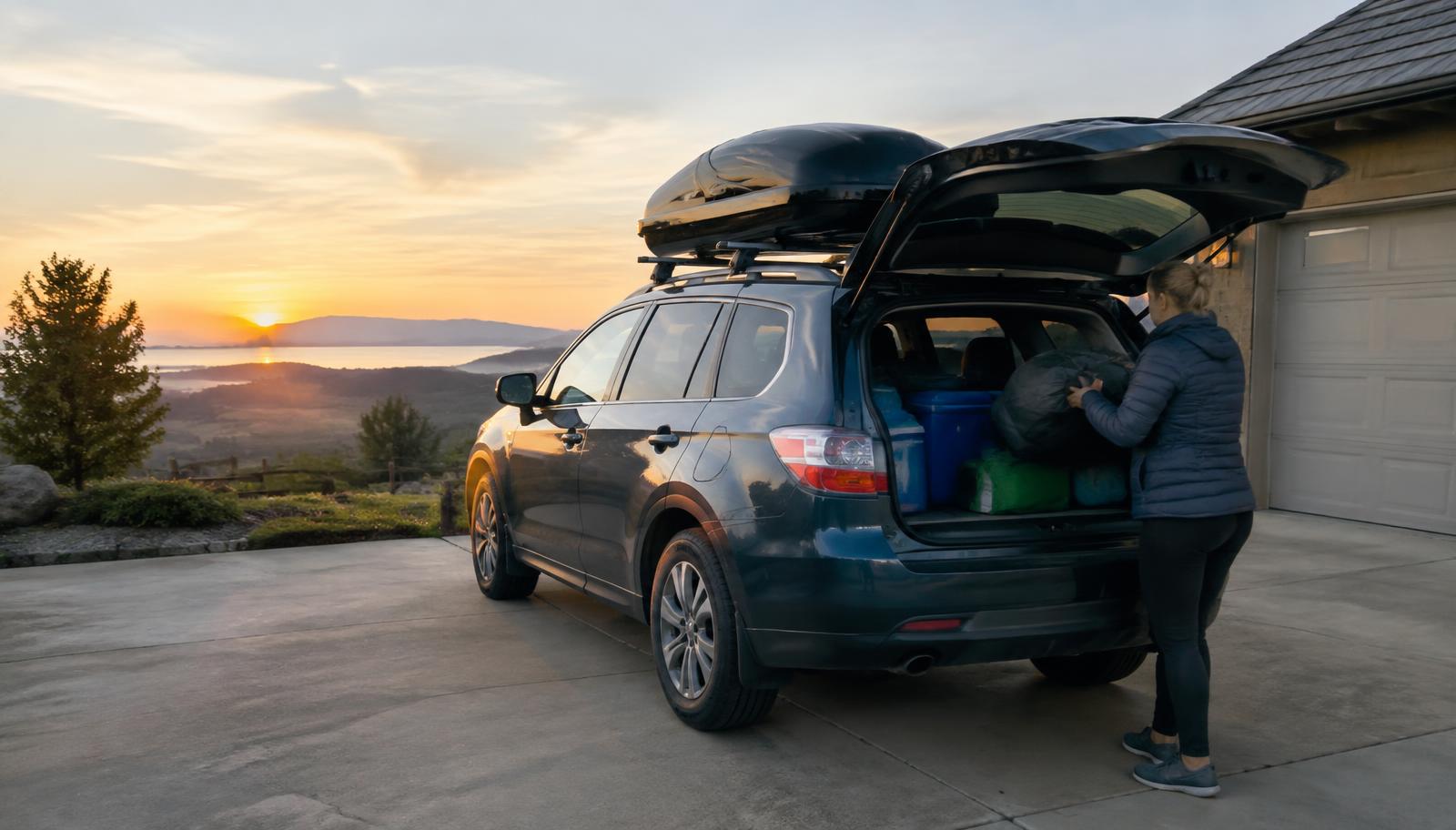
Most road trips fail in the same place. Not on the road, but in the two weeks before it, when the plan lives in six browser tabs, a notes app, and somebody's memory.
This is the exact process we use to plan a road trip that survives contact with real driving hours, real fuel costs, and real tired people at 7pm. It works for a weekend loop or a three week route across a continent.
The short version
If you only read one section, read this.
- Pick the two anchors: where you start, where you end.
- Set the number of days before you set the stops.
- Cap driving at 4 hours a day, 5 if the drive itself is the attraction.
- Add stops in geographic order, not in order of excitement.
- Book the nights that are hard to get, leave the rest open.
- Price the trip per day, not per trip.
- Put the whole itinerary in one place your passengers can open.
Everything below is the detail behind those seven steps.
Step 1: Choose your two anchors first
A road trip itinerary needs a start point and an end point before it needs anything else. Those two anchors decide the shape of the trip.
There are three shapes worth knowing:
- Loop. Start and end in the same city. Best when you fly in and out of one airport or drive your own car.
- Point to point. Start in one city, end in another. Best scenery per hour, but check one way rental fees first.
- Hub and spoke. One base, day trips out and back. Best with kids, bad weather, or a slow travel week.
Pick the shape now. It changes every decision after this.
Step 2: Set the days before you set the stops
The most common planning mistake is collecting stops first and then trying to squeeze them into a week. It always produces a trip with three hours of driving too many per day.
Work the other way around. Write the number of days you actually have, then subtract:
- The arrival day, which is usually half a day at best.
- The departure day, which is usually a morning.
- One buffer day for weather, illness, or a place you like enough to stay in.
A "7 day road trip" is realistically 4 to 5 planning days. Plan for those.
Step 3: Cap your daily driving
Driving time is the single number that decides whether a trip feels good or feels like a commute.
| Trip type | Comfortable daily drive | Realistic stops per day |
|---|---|---|
| Scenic coastal or mountain | 2 to 3 hours | 3 to 4 |
| Standard sightseeing route | 3 to 4 hours | 2 to 3 |
| Transit day, covering distance | 5 to 6 hours | 1 |
| With small children | 2 to 3 hours | 2 |
Two things people forget. First, mountain and coastal roads take 30 to 50 percent longer than the map estimate once you add photo stops. Second, every stop costs 30 to 90 minutes with parking, walking, and coffee, so four stops is not four times fifteen minutes.
A good rule: if the day has more than four hours of driving and more than three stops, it is two days pretending to be one.
Step 4: Add stops in geographic order
Once the days are set, add places. Then reorder them so the route never doubles back.
Backtracking is where hours disappear. A stop that is 40 minutes off the line costs 80 minutes plus the visit, so it needs to earn that.
For each candidate stop, ask three questions:
- How far off the main route is it?
- How long do we realistically spend there?
- Does it fit the day's energy, or is it a second museum in a row?
This is exactly why we built Tripvora to reorder your stops geographically and show the driving time between each one, instead of leaving you to guess from a list.
Step 5: Book only what is hard to get
Over booking kills the best part of a road trip, which is the freedom to stay another night somewhere good.
Book in advance:
- Nights in national parks, small islands, and popular towns in high season.
- Ferries, tunnels, and mountain passes with limited capacity.
- Timed entry attractions that sell out weeks ahead.
- The first and last night, so arrival and departure are never stressful.
Leave flexible:
- Mid route nights in larger towns.
- Restaurants, with the exception of one or two special meals.
- Anything in shoulder season outside major hubs.
Step 6: Price it per day, not per trip
A per trip budget is a guess. A per day budget is a plan you can check against reality on day three.
Build it from five lines:
- Fuel
- Total km divided by your car's litres per 100 km, times local fuel price
- Accommodation
- Nightly rate times nights, add 10 percent for taxes and fees
- Food
- Per person per day, split into a cheap day and a nice day
- Entries and parking
- 15 to 30 per person per active day is a safe placeholder
- Buffer
- 10 to 15 percent of everything above
Tolls and city parking are the two lines that surprise people most, especially in Italy, France, and Spain. Check them per country before you leave.
For a full breakdown with worked numbers, see our road trip budget guide.
Step 7: Keep the whole plan in one place
The plan only works if the person in the passenger seat can open it. Screenshots in a group chat do not survive day two.
Whatever tool you use, the itinerary should show:
- Each day as its own block, in order.
- Driving time and distance between consecutive stops.
- Where you sleep that night.
- One tap to send the next stop to Google Maps or Apple Maps.
That is the whole job of a road trip planner. Not inspiration, but structure you can drive.
Common mistakes to avoid
- Planning by attraction list. Attractions are not a route. Order them by geography first.
- Ignoring check in times. A 3pm check in and a 5 hour drive do not both fit before dinner.
- Forgetting the return. The drive back to the airport is a real day, not an afterthought.
- No rest day. On trips longer than five days, one slow day makes the rest better.
- Underestimating small roads. A 60 km mountain road can take two hours.
Frequently asked questions
How many hours should you drive per day on a road trip?
Three to four hours is the sweet spot for a sightseeing day. Five to six is fine for a pure transit day, but do not schedule two of those back to back.
How far in advance should you plan a road trip?
Four to six weeks for domestic trips in normal season, and three months if you need national park lodging or high season coastal towns.
What is the best way to plan a road trip itinerary?
Set the days first, cap the daily driving, then place stops in geographic order and check the driving time between each pair. Tools that reorder stops for you save the most time here.
Is Google Maps enough to plan a road trip?
Google Maps is excellent for a single route on a single day. It is weak at multi day structure, per day driving budgets, and keeping a whole trip in one shareable place.
Plan yours in the next ten minutes
Pick your start and end point, set the days, and let the route order itself. That is the entire first pass, and it takes less time than reading this article.
Start planning your road trip with Tripvora and see the driving time between every stop before you commit to the plan.
Follow along on YouTube, TikTok, and Instagram for real routes we drive and film.
Let the planner do the heavy lifting
Once you know your start, end and dates, the AI road trip planner suggests stops along your actual route, splits them into days, and keeps the drive times honest.
Keep reading: Road trip budget guide · How to plan a multi-stop road trip · Best road trip routes in Europe